
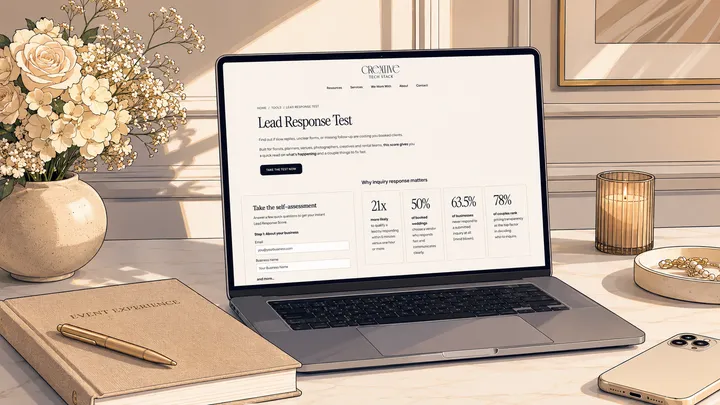
You already know something is broken. A couple reaches out, you reply, and then nothing — no follow-up, no booking, just silence. It keeps happening, and the question isn’t whether your process has a leak. It’s which part.
The answer is almost always one of four things: how fast you reply, what your reply actually says, how much friction is in your contact form, or whether your emails are landing in spam. Most vendors assume the problem is pricing or competition. Usually it isn’t.
Here is how each piece works — and what the gaps typically look like.
The First Five Minutes Matter More Than You Think
If there is one benchmark worth knowing, it is this: vendors who respond within five minutes are 21 times more likely to qualify the same lead than vendors who respond an hour later.
That is not a rounding error. That is a completely different conversion rate.
Here is why it matters so much for wedding vendors specifically. When a couple fills out your contact form, they are almost certainly filling out two or three others at the same time. They are in research mode, comparing options, and whoever replies first has a real structural advantage. WeddingPro found that 50% of booked wedding contracts go to the first vendor who responds. Not the best vendor. Not the cheapest. The first.
For context: a 2026 study found that 63.5% of businesses never respond to submitted inquiries at all. If you reply consistently, you are already ahead of most of the market. The question is whether you are replying fast enough to matter.
Speed Is Not Enough If the Reply Is Generic
Let’s say you do reply quickly. The couple still might not book if the reply itself does not do any work.
A lot of vendor replies look like this: “Thanks so much for reaching out! I would love to chat about your event. Here is my calendar link.” That reply confirms you exist. It does not give the couple a reason to move forward with you specifically.
A reply that converts does three things. It acknowledges something specific about their event. It gives them enough pricing context to know whether you fit their budget. And it tells them exactly what to do next, whether that is booking a call, reviewing a package guide, or filling out a short questionnaire.
Without those three things, a fast reply is just a fast way to get ignored. And 78% of couples say pricing transparency is the top factor in deciding whether to follow up after an initial inquiry, so even a ballpark investment range can be the difference between a response and radio silence.
Your Contact Form May Be Losing Them Before They Even Reach You
Some leakage happens before you ever get a chance to reply. If your contact form asks for too much upfront, couples abandon it — and you never know they were there.
The sweet spot is five fields or fewer. Name, email, event date, event type, and a freeform notes field. Every field you add after that increases the chance someone will abandon the form before they ever reach you. If your form is on a page that loads slowly or is hard to complete on a phone, you are compounding the problem. The majority of couples are researching wedding vendors on mobile.
This is one of the easier things to fix, and the impact on inquiry volume can be significant.
The Leak That’s Hardest to Spot
There is one category most vendors never check. If your replies are landing in the prospect’s spam folder, the couple is not ghosting you. They just do not know you replied.
This is more common than it sounds, especially for vendors sending from shared hosting email addresses or services without proper authentication set up. And it is nearly invisible from your end since the emails look like they sent fine.
A follow-up sequence helps here too. If your first reply gets no response within 24 to 48 hours, a short and polite check-in is often the difference between a booked consultation and a dead lead. Most vendors never send one.
Stop Guessing Which Part Is Broken
Most vendors know they are losing bookings somewhere. The problem is they are guessing at which part — and fixing the wrong thing.
The Inquiry Score scores your process across four areas: response speed, reply content quality, contact form setup, and technical deliverability. Two minutes, a score out of 100, and a plain-English read on exactly where the gaps are.
If it comes back High Risk or Critical, you know which pillar to fix first. If it comes back Good or Elite, you know where the next lever is.