
Five years ago, a couple looking for a wedding florist in their area would open Google, type a phrase like “wedding florist Denver,” scroll through results, and visit a few websites.
That process still happens. But it is no longer the only process, and for a growing segment of couples, it is not even the primary one.
How discovery has changed
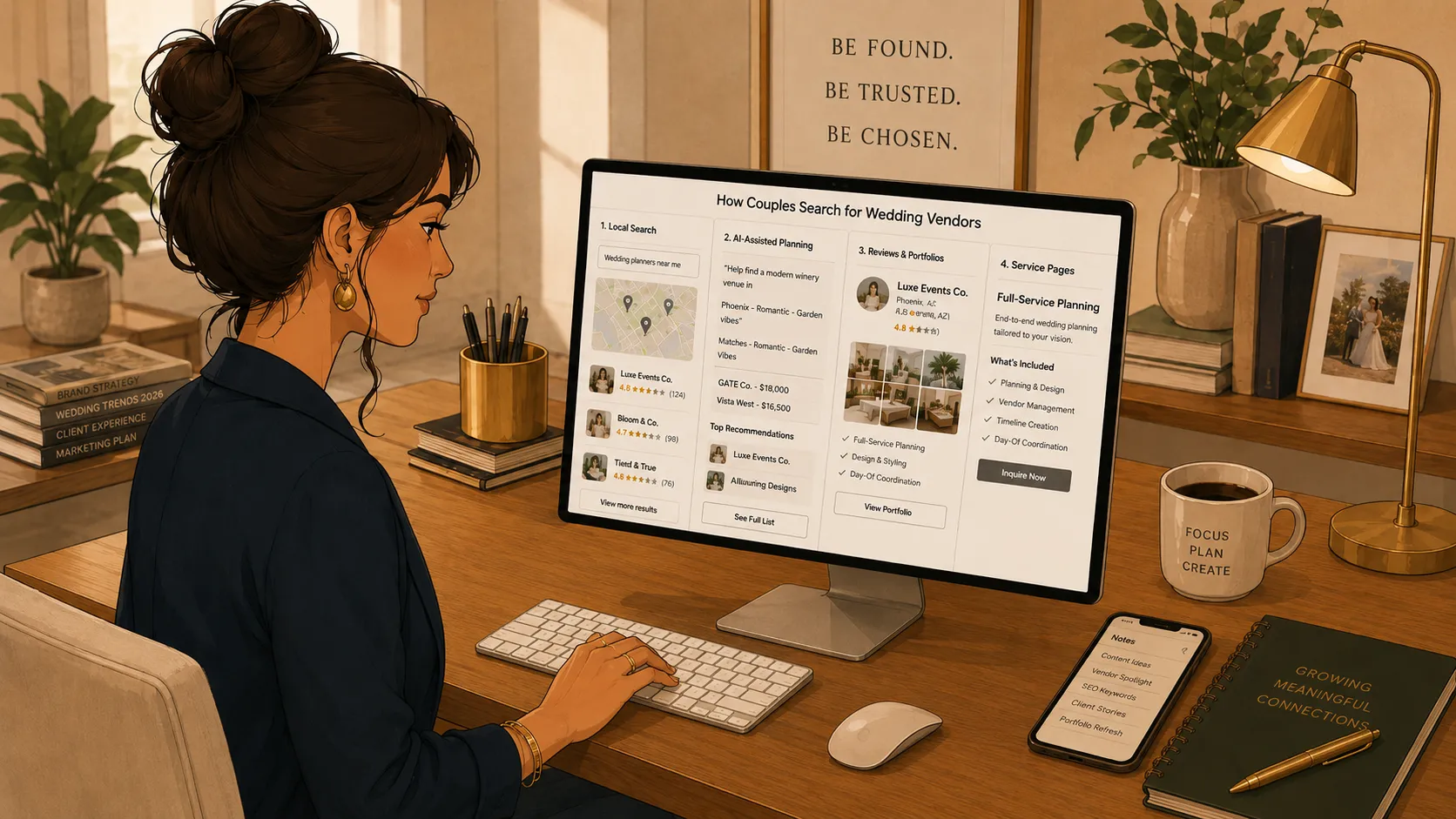
The Knot Worldwide’s 2026 Real Weddings Study found that 36% of engaged couples are now using AI tools in their wedding planning. That includes ChatGPT, Google Gemini, Perplexity, and similar platforms that answer planning questions conversationally rather than returning a list of links.
When a couple asks an AI planning tool for florist recommendations in their area, the results are not pulled from a live search index. They come from the information the AI was trained on, combined with whatever it can retrieve about local businesses: your website content, review profiles, structured data, and how clearly your business is described across the web.
If your business is not well represented in those sources, it may not appear at all.
The two-layer discovery problem
Wedding vendors now need to think about visibility on two levels.
Traditional local search rewards businesses with well-optimized pages, strong Google Business Profiles, positive reviews, and content that matches how couples search by location, style, and event type.
AI-assisted discovery rewards businesses whose content is structured, clear, and useful. AI tools favor businesses that describe what they do, who they serve, where they work, and what the next step looks like. Vague websites and thin content are easy to overlook.
The vendors winning in both channels share a common quality: their content is written for how couples think, not just how algorithms rank.
What couples are actually asking
AI planning tools tend to get very specific questions.
A couple might ask: “What are the best full-service wedding planners in Austin for a 150-person outdoor wedding?” or “Which florists near me specialize in garden-style arrangements?” or “How much does a wedding photographer in Charleston typically cost?”
If your website does not have content that answers those kinds of questions: your service area, your specialties, your event types, your process, your typical client, an AI tool has little to go on.
That is the same problem that has always existed in local SEO, but the consequences are more immediate. A Google result you do not appear in is missed traffic. An AI recommendation you are not part of is a couple who never considers you.
What to do about it
The foundation is the same across both channels: useful, specific, well-organized content.
That means service pages that describe what you actually do, not just that you are “passionate” about your work. Location pages or references that tell a planning tool where you operate. FAQs that match the real questions couples ask before they inquire. Reviews and proof that signal trust.
It also means your Google Business Profile, marketplace listings, and any third-party profiles are accurate, complete, and consistent. AI tools pull from all of these sources when building a picture of your business.
The vendors who show up in AI-assisted discovery are not doing something exotic. They are describing their business clearly, in the same language couples use when they are ready to hire.
The bottom line
Search has not disappeared. It has expanded.
Couples are now finding vendors through Google, through AI planning tools, through marketplaces, through referrals, and through venue recommendation lists. A visibility strategy that only covers one of those channels is leaving real opportunities uncovered.
Getting found in 2026 means making sure your business is easy to understand, well-described, and consistent across every surface where a couple might encounter it, human or AI.
If you are not sure how your business shows up in local search or AI planning tools, a visibility audit can tell you where the gaps are. See how we improve local SEO and AI discovery →